
Maids at Tokyo cafe ramp up efforts to attract foreign visitors
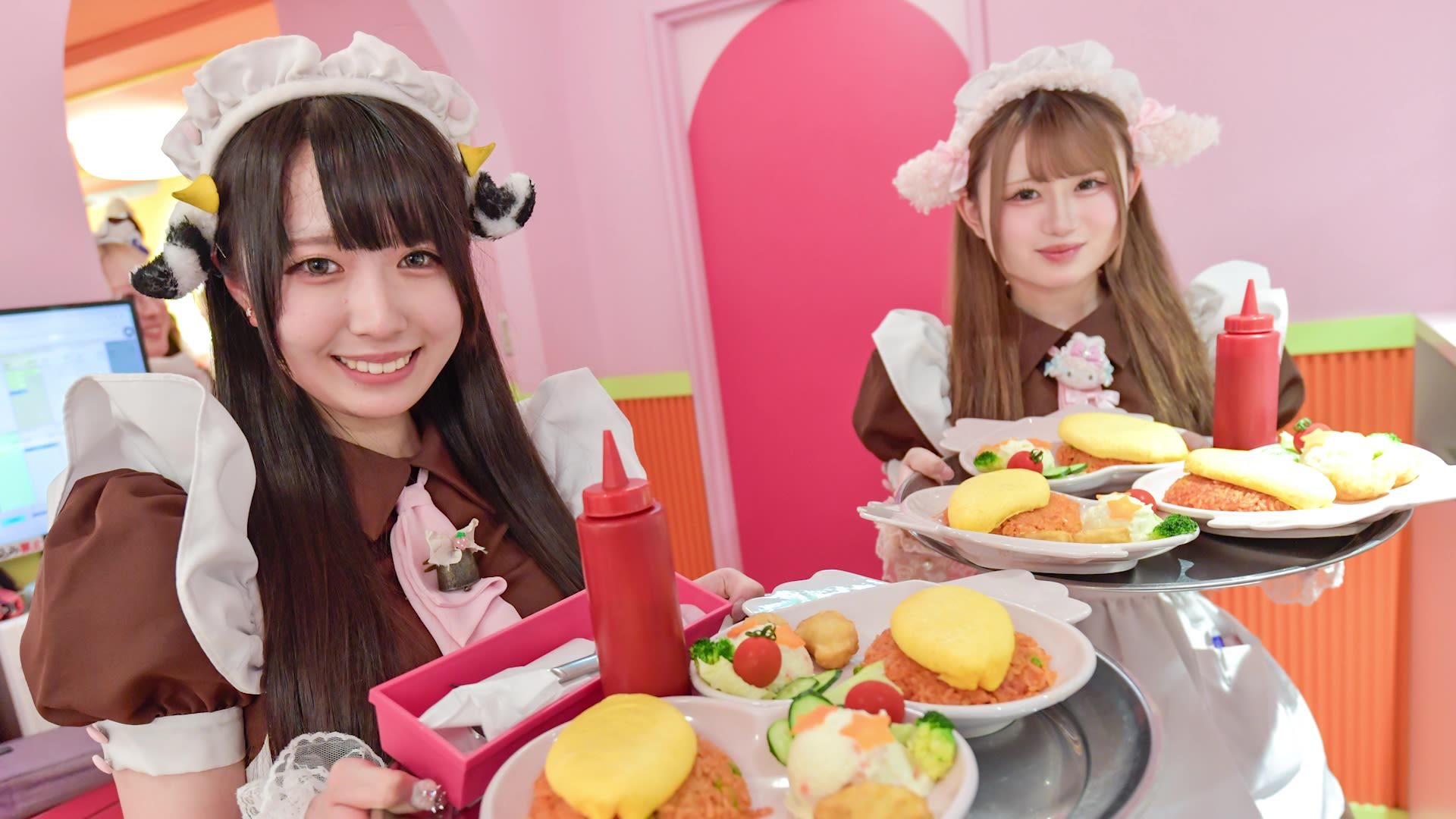

AAt a cafe in Tokyo's famed Akihabara district, "maids" are increasingly learning to accommodate foreign visitors by studying English phrases and handing out specialized gifts.
Known as a mecca for Japan's "otaku" subculture, Akihabara is packed with goods related to popular anime, manga and video game series and is also believed to be the birthplace of maid cafes.
The cafes are a Japanese phenomenon where predominantly female staff dress in maid costumes and act as servers and entertainers for their customers. They often refer to customers as "Master" or "Princess."
At-home cafe is one of the best-known maid cafes and claims to be the birthplace of the now-famous "Moe Moe Kyun" spell, which maids say while making a heart shape with their hands before customers eat to make their meals "more delicious."
"Moe" is a Japanese slang term denoting strong affection toward something, usually a fictional manga or anime character, and is widely used in the maid cafe world.
At-home cafe, now a chain of 13 cafes in Tokyo, Osaka and Nagoya with more than 700 maids, has an elaborate hierarchy in which maids are distinguished by rank and uniform color. The cafe is home to many famous maids and even sells maid-related merchandise.
According to the cafe, maids serve their Masters and Princesses and are blessed with a magical spell that makes them "forever 17 years old."
"Let me show you inside the mansion," said Mishina, one of the cafe's Premium Maids.
As she guides customers inside, she rings a bell while announcing that "Master is home," to which all the other maids respond gleefully in unison: "Welcome home, Master!"
While the submissive language, frilly costumes and high-pitched voices may give unfamiliar visitors the impression that the maids are being sexualized, the cafe has a strict no-touching policy, can limit the length of visits and does not allow customers to ask maids for personal information or about their private lives.
The industry is booming, with the most famous maids attracting large social media followings. The Japanese phenomenon of "oshi-katsu," in which diehard fans spend significant amounts of time and money supporting their favorite idols or characters, has also fueled the trend, with customers repeatedly returning to see their favorite maids.
The cafe is family-friendly, with women accounting for about 70 percent of its customers. Its clientele ranges from businessmen and high school students enjoying "oshi-katsu" to a growing number of overseas tourists.
Foreign visitors to Japan in 2025 hit an estimated record of 42.7 million, with their spending also at a new all-time high of 9.5 trillion yen ($xx).
Amid the tourism boom, at-home cafe has introduced conversational English lessons to help the maids accommodate the growing number of foreign customers.
"I still cannot make perfect sentences, but sometimes I can express myself just by putting words together," one maid said. "It's reassuring."
Foreign customers are also often given "Moe chopsticks" featuring the flags of their home countries and regions. "They are so delighted by that," Mishina said.
"For Masters and Princesses who learn about Japanese culture and come to enjoy it, we are always eagerly waiting for you at the mansion," she said.
"We'll always be waiting for you to come home."
Other Spotlight Japan Stories
Japan virtual idols' "human" side unveiled as VTuber boom spreads globally
ith flashing lights, choreographed dance moves and fans singing along to her songs, Kizuna AI commanded two days of sold-out concerts in front of thousands in Tokyo like any pop idol at the height of her fame.
School experience helping tourists scrub up on Japanese education
Asking students to clean their classrooms might seem unusual to some, but in Japan it is an unquestioned part of school life and a practice that embodies an education system that is increasingly viewed globally as one that promotes responsibility and collaboration.
Foreign tourists showing appetite for Japan's art of food replicas
At a workshop in Tokyo, a dozen or so tourists watched as green and white wax was poured into warm water. As the liquid turned into a sheet, they were then asked to slowly pull it up and roll it, gasping at its transformation into a lettuce.
Japan's neon-decorated trucks dazzle for New Year's disaster relief
An unremarkable riverside near Tokyo was transformed into a neon wonderland on New Year's Eve as enthusiasts gathered to enjoy a showcase of one of Japan's most vibrant subcultures.
The Company uses Google Analytics, an access analysis tool provided by Google. Google Analytics uses cookies to track use of the Service. (Client ID / IP address / Viewing page URL / Referrer / Device type / Operating system / Browser type / Language /Screen resolution) Users can prevent Google Analytics, as used by the Company, from tracking their use of the Service by downloading and installing the Google Analytics opt-out add-on provided by Google, and changing the add-on settings on their browser. (https://tools.google.com/dlpage/gaoptout) For more information about how Google handles collected data: Google Analytics Terms of Service (https://policies.google.com/technologies/cookies?hl=en#types-of-cookies) Google Privacy & Terms(https://policies.google.com/privacy)
© Kyodo News. All Rights Reserved. No reproduction or republication without written permission.
 Built with Shorthand