
Japan virtual idols' "human" side unveiled as VTuber boom spreads globally

With flashing lights, choreographed dance moves and fans singing along to her songs, Kizuna AI commanded two days of sold-out concerts in front of thousands in Tokyo like any pop idol at the height of her fame.
Yet the artist never physically set foot on stage. Kizuna AI is not human, but a two-dimensional, anime-style avatar -- known as a "virtual YouTuber," or VTuber -- whose movements and voice are provided by real people behind the scenes.
A YouTube video of Kizuna AI introducing herself following her debut. (Screenshot from Kizuna AI - A.I.Channel)
A YouTube video of Kizuna AI introducing herself following her debut. (Screenshot from Kizuna AI - A.I.Channel)
Debuting in 2016 under digital entertainment firm Activ8 Inc., Kizuna AI is often credited with popularizing the term VTuber and paving the way for virtual entertainers with massive livestream audiences.
Voice actor Nozomi Kasuga revealed in 2020 that she was the voice behind Kizuna AI -- a rare move, as VTubers typically keep their real identities hidden. For some, a VTuber's virtual nature is part of the appeal, making them more relatable and accessible than human idols.
Kizuna AI is adored by more than 3 million YouTube followers today, maintaining her popularity even after going on hiatus in 2022 and resuming activities in February last year.
"I love Ai-chan so much, and I was really sad not being able to see her during her hiatus," said Guo Zhaoheng, 26, who came from China to see Kizuna AI's comeback show at a concert hall in Tokyo's Shinjuku area in September. "I even wore this outfit that she loves. I was so happy to come that I almost cried."
The virtual idol was created by Takeshi Osaka, 40, now Activ8 CEO, and Junji Matsuda, 40, CEO of his own virtual talent firm, Take1 Inc., based on the concept of an "artificial intelligence program" eager to understand humans who created her.
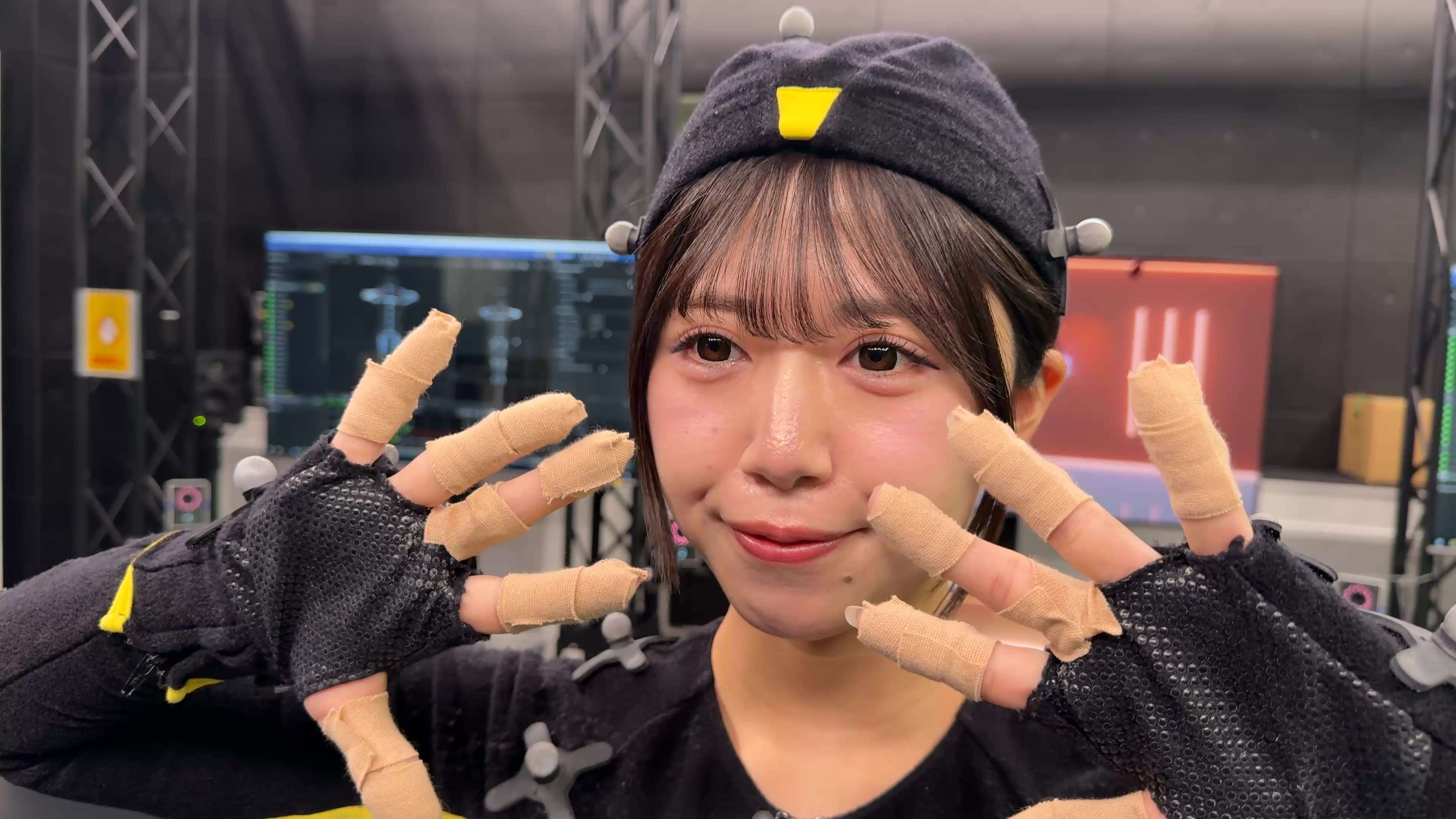
Still, her performances are the result of extensive human involvement. While amateur VTubers need little more than a webcam and the right software to assume their personas, firms like Activ8 bring them to life in sophisticated studios.
At one such studio in Tokyo's Shinjuku Ward, an avatar mirrored the moves of dancer and choreographer Amika, 25, who wore a motion-capture suit in a room fitted with 28 motion-sensing cameras that pointed at her from all directions.
"I often watched VTuber videos, and thought it would be great to get into VTuber choreography now that online content has such a large and constantly growing audience," she said.
Amika was introduced to the job by Yuka Araki, 30, who has long choreographed for Kizuna AI and now runs her own talent agency, including casting for motion-capture roles.
Araki said the rise of VTubers has increased work opportunities for dancers.
"People used to join dance schools wanting to be backup dancers, but now many are joining specifically to become motion-capture actors. The scope of what you can do as a dancer has expanded so much," she said.
"It is a big deal that characteristics like age or physical appearance do not matter in motion-capture acting," she said. "I know many who aspired to become idols but could not achieve those goals, but instead went on to become successful VTubers."
The idea of Kizuna AI was conceived by Matsuda and Osaka after they met as university students. Growing close, the two continued meeting regularly after graduation and eventually began combining their dreams of creating an online character with starting a business.
"I thought it would be cool if a 2D character became a YouTuber," Matsuda said, adding that Kizuna AI debuted at a time when many creators were uploading to YouTube almost daily, and the pair saw an untapped market for virtual characters doing the same.
The idea to incorporate "AI" into the character's name -- written the same as AI but pronounced "eye," like the Japanese word for love -- came from Osaka, while Matsuda devised the name "Kizuna," meaning bond or connection, reflecting the character's desire to connect with and understand human beings.
Osaka attributed Kizuna AI's visual design, voice and overall presence to her enduring popularity, saying, "The character design deliberately leans into Japanese anime aesthetics without becoming too sexualized."
"We aimed for anime-like cuteness that would not alienate the general public," he added.
The Japanese and overseas receptions were very different, Osaka said, noting that many people overseas embraced Kizuna AI's concept at face value as a living anime character, while Japanese anime fans were initially slow to respond but eventually embraced her as the VTuber boom took off.
The Japanese phenomenon of "oshi-katsu," in which diehard fans spend a significant amount of time and money to support their favorite idols or characters, has also become essential for VTuber survival, he said.
A YouTube video of Kizuna AI introducing herself following her debut. (Screenshot from Kizuna AI - A.I.Channel)
A YouTube video of Kizuna AI introducing herself following her debut. (Screenshot from Kizuna AI - A.I.Channel)
"We are constantly consuming through social media and can follow what idols or VTubers are doing 24/7, 365 days a year," he said. "With such direct access, it feels like we can get more hooked on them than ever before."
Kizuna AI held shows at several overseas locations during her comeback year, including Canada and Malaysia.
"As a music artist, we want her to do even more, such as play at overseas festivals like Coachella (Valley Music and Arts Festival in California) and collaborate with international artists," Osaka said.
Kizuna AI now not only contends with countless new VTubers emerging on the scene, but also an entertainment industry increasingly impacted by AI-generated content.
"But no matter how much technology advances, people will always be drawn to the sense that there is somebody (behind the character) working hard and striving to create," he said.
"Even if AI can easily create images or videos, I think that will simply establish a new baseline. Ultimately, people will keep looking for traces of human effort."
Photo & Video : Fumine Tsutabayashi
Other Spotlight Japan Stories
Sailor Moon's magic endures as new theater set to open in Tokyo
More than 30 years after Pretty Guardian Sailor Moon first sparked a global phenomenon and established the fighting magical girl genre, the franchise continues to evolve with the opening of a new permanent theater in Tokyo staging performances throughout the year.
Japanese underground idol culture booming in China
At a club in Shanghai, dozens of young people are jumping and waving glow sticks as they dance to the music, leaning in as if to touch the performers on stage. They're Chinese amateur girl groups singing in Japanese, and this is Japan's globalized idol culture..
Foreign tourists showing appetite for Japan's art of food replicas
At a workshop in Tokyo, a dozen or so tourists watched as green and white wax was poured into warm water. As the liquid turned into a sheet, they were then asked to slowly pull it up and roll it, gasping at its transformation into a lettuce.
Japan's neon-decorated trucks dazzle for New Year's disaster relief
An unremarkable riverside near Tokyo was transformed into a neon wonderland on New Year's Eve as enthusiasts gathered to enjoy a showcase of one of Japan's most vibrant subcultures.
The Company uses Google Analytics, an access analysis tool provided by Google. Google Analytics uses cookies to track use of the Service. (Client ID / IP address / Viewing page URL / Referrer / Device type / Operating system / Browser type / Language /Screen resolution) Users can prevent Google Analytics, as used by the Company, from tracking their use of the Service by downloading and installing the Google Analytics opt-out add-on provided by Google, and changing the add-on settings on their browser. (https://tools.google.com/dlpage/gaoptout) For more information about how Google handles collected data: Google Analytics Terms of Service (https://policies.google.com/technologies/cookies?hl=en#types-of-cookies) Google Privacy & Terms(https://policies.google.com/privacy)
© Kyodo News. All Rights Reserved. No reproduction or republication without written permission.
 Built with Shorthand